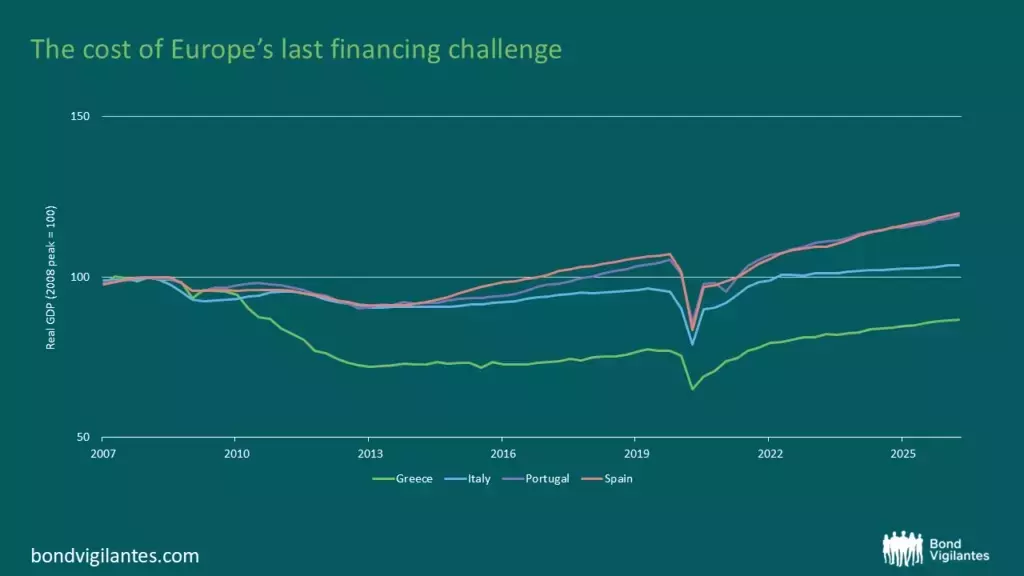
In 2012, European nations grappled with significant financing hurdles, a situation ultimately resolved through a blend of resolute political determination, decisive central bank intervention, and stringent fiscal discipline. Today, France faces a comparable challenge, prompting a re-evaluation of these past strategies. The core question revolves around whether the nation will embrace a similar path of austerity, or if its unique political landscape necessitates a different resolution for its government securities.
France's Current Economic Predicament and Historical Precedents
France finds itself at a critical economic juncture, reminiscent of the broader European sovereign debt crisis of 2012. Back then, countries like Greece, Portugal, and Spain endured severe economic contractions, with Greece's real GDP plummeting by over a quarter from its 2008 peak. Portugal and Spain each saw nearly a tenth of their output vanish, and Italy's economy did not return to its 2008 levels until 2022. These nations, though scarred, ultimately emerged stronger, primarily due to painful reforms, central bank assistance, and a subsequent reduction in borrowing costs, which facilitated refinancing at sustainable rates. This arduous journey led to a recovery in their sovereign credit ratings, confirming the efficacy of a 'Pain Inflicted, Get Stronger' (PIGS) strategy.
Today, France, an influential member of the Eurozone, presents a significant economic challenge. While the collective GDP of the heavily impacted countries in 2011 accounted for 31% of the Euro area's total, France's current GDP represents 18%. This suggests that, in terms of relative economic magnitude, the Eurozone has historically managed larger crises. However, the critical distinction lies in France's willingness to undertake the necessary fiscal adjustments. The nation's most recent budget, despite identifying 54 billion euros in savings, only marginally reduces the deficit from 5.4% to 5.0% of GDP. This projection is built on growth assumptions that even France's own fiscal oversight body views as overly optimistic. Stabilizing the national debt at current yields would necessitate a primary surplus exceeding 2% of GDP, a figure significantly higher than France's historical average. Furthermore, the upcoming 2027 presidential election introduces considerable political uncertainty, with potential outcomes ranging from a National Rally victory to proposals from the far-left, like Mélenchon, to entirely cancel French government debt.
The European Central Bank (ECB) played a pivotal role in the 2012 resolution, but its support is contingent on fiscal responsibility. With France's persistent deficit and optimistic budgetary outlook, it may not be an obvious candidate for immediate ECB intervention. If other Eurozone countries demonstrate sound fiscal management, they might receive ECB assistance, potentially leaving France in a more precarious position. Moreover, the impending departure of ECB President Lagarde in February 2027, and the likelihood of her successor not being French, could diminish the ECB's inclination to offer Paris preferential treatment. The path forward for France thus appears to be a stark choice: embrace the 'Pain Inflicted, Get Stronger' model, enduring short-term hardship for long-term stability, or risk a more drastic measure, such as a 'French Restructuring Of Government Securities' (FROGS).
The unfolding economic narrative in France serves as a powerful reminder that fiscal stability demands unwavering political resolve and a commitment to difficult reforms. While the 'Pain Inflicted, Get Stronger' path is historically proven, the unique confluence of France's domestic politics and the evolving dynamics of the Eurozone may necessitate innovative, albeit potentially disruptive, solutions. The choices made in the coming months will not only shape France's economic future but also have profound implications for the broader European financial landscape.